Friday, February 3, 2017

Dull Knitting

I've been doing more to improve my knitting than simply using up older stashed yarn. I have been trying to produce practical sweaters that I will wear often. Here's a catch-up listing of those, as proof that my knitting projects are not all brightly colored. As always, complete details are in my Ravelry projects. Most of these were knit in 2016.

Lifesavers Cardigan pattern, Tanis Blue Label yarn
I never thought I'd knit a sweater with fingering weight yarn, even though I bought it in Canada for that purpose.  Once I finished it, I found I like it. It is just warm enough and very comfortable.
Portage cardigan pattern, Zara yarn
This superwash yarn makes a heavier sweater.  It doesn't have buttons, so is wearable despite the weight.
Wanderling pattern, Elsa Wool fingering weight yarn
This is a fabulous yarn for a sweater, soft, warm, light and lovely to knit.  The pattern is cute, but the cables pull in, affecting the fit in the shoulders.  That's a small defect, though.  I love wearing this sweater.

Lightweight Raglan pattern, Berroco Ultra Alpaca Fine yarn
Lovely pattern, good in this yarn, but would probably be better in a less elastic blend.  It is a practical sweater, simple and comfortable except for a small itchy spot in the front of the neck.  I can loosen the neckline a little--I tightened it up by shifting the stitches at the welt--or put in a facing in a softer yarn.
Yoke sweater of my own design using cvm yarn from local mill
This wool is very itchy, making it a challenge to design a sweater that I can wear comfortably.  I think it is a success but will know for sure after next winter. 

Gehry pattern, Brooklyn Tweed Loft yarn
This sweater wasn't quite done when I took this photo, but it is completed now.  I have worn it, but wish I'd knit a smaller size.  The yarn is nice and light, but too itchy for me.

Truss pattern, Cascade Cloud yarn
This pattern is not as flattering as I thought it might be and the yarn is heavy. Still, it is a comfortable weight and goes with all my black and gray, as well as blue jeans.

Definitely Susan pattern, Madeline DK yarn, the single spun
Gosh, I love this.  It took me a couple of years to get around to knitting the scarf.  I'm so glad I finally made it because it makes the sweater a lot more fun to wear.  The yarn is superwash but the sweater is so small that it isn't heavy.  Or maybe the Tosh Merino DK is just a lighter spun yarn.

There they are, the sweater output brought up to speed.  I'm glad I listed them, as it points to an issue I've been ignoring for years.  I can't wear most wool comfortably.  I tried to buy more rustic yarn last year, but I found them more itchy than the superwash yarns I've bought in the past.  Since I'm tired of working with the way superwash stretches out of shape, I've concluded that I should explore (shock) acrylic or acrylic blends as well as confining my purchases to alpaca, merino, cormo, or other soft yarns.  Now that I've knitted up a backlog of sweater yarn and explored some of the new options, I can make my purchasing more practical, as I've done with my choice of colors and patterns. 

Monday, January 30, 2017

The Meaning of My 2016 Knitting

In 2016, a lot of my personal items were damaged by a flood.  This was a difficult time for me, emotionally and physically.  Of course, I kept knitting through the trashing, sorting, treating, cleaning, repairing and restoring that was required.  That I kept knitting, finishing up current projects and starting new ones didn't surprise me.  What surprised me was that I suddenly looked at my stash with new eyes. 

I had a few hanks of yarn that I had chosen for color.  These hanks were pleasant in appearance but overly bright and clashing when knitted up.  Suddenly, during the period immediately after seeing a lot of my personal items looking particularly dirty and soggy, these bright colors called to me.  Something I was never going to knit seemed like the ideal thing to knit.  That was how I discovered that knitting with yarn that is bright and maybe not so beautiful can be helpful in crisis.

Of course, I was reasonable, choosing patterns for accessories that might mix into a wardrobe of neutrals and limiting myself to two projects.  There was a Carlisle scarf with a central color of chartreuse sock yarn.  I found enough sock yarn in my stash to complete the scarf.


Then there was a variegated sport-weight bfl that was a riot of green, yellow, and brown.  I bought some lovely black Anzula Cricket to use with it and produced a Marley shawl that is appalling on the wrong side.


However, the right side is moderated by the black.  Since I only wear such large shawls at home on chilly days, I find the bright colors cheerful on a gloomy day.  The yarn itself is lovely--very soft and comfortable.  If I tire of the colors, I could always dye it black.


I worried while I was knitting these projects that I was wasting my effort.  Now that they are completed, I am happy with them.  I am also happy that they took these yarns out of my stash.

 
Although these are only two projects, they were crucial in my destashing plan. They took it from a mere reduction of the quantity to more nearly a complete clearing of stashed yarn.  I suddenly became more determined to eliminate my stash.

Wednesday, December 3, 2014

Maximix Knee Socks

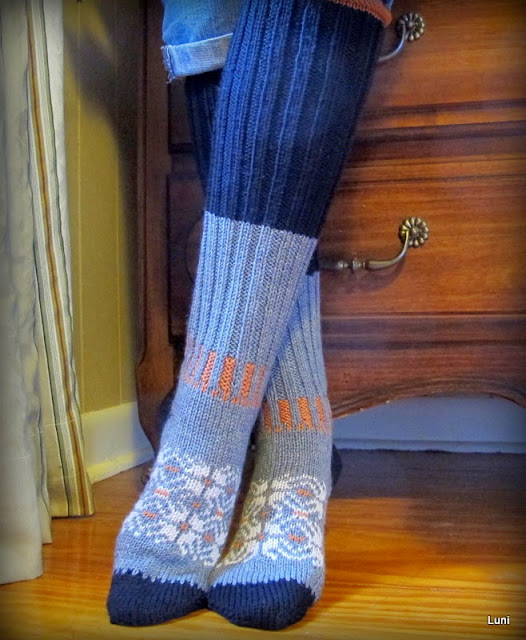
My latest pattern is available through the link below as well as on Ravelry.com. Maximix Knee Socks offer a means of combating two problems that beset knitters in the Winter, cold feet and pattern boredom. I've tested the benefits of knee socks in the cold and feel confident in the statement that where wool socks are good at preventing cold feet, knee-length wool socks are even better. I'd have knitted more knee socks but for one problem--they take a long time to knit. I developed this pattern to overcome that problem.  Using heavier-weight sock yarn, sport-weight yarns, and even dk-weight yarn makes these socks warmer and quicker to knit.  The changing patterns keep the knitting interesting.


Maximix knee socks use heavier yarns knit at a larger gauge than regular socks. Since thick socks don't fit well in most shoes, the heaviest yarn is reserved for the leg of the sock. To keep the foot warm and snug, there's a bit of stranded knitting between the toe and the short-row heel. Contrasting colors add interest and make it possible to use bits of leftover yarn. I'm so pleased with the comfort and warmth of these socks that I just knit a second pair.


While I knit the second pair, I checked the pattern and tried out a few modifications. The final result is my best version of this pattern, which I hope experienced knitters will find both practical and fun in its approach to knee socks. I'm making it available for free . Click this link:
download now
or click this one to go the the pattern page on Ravelry:

Maximix


Saturday, April 19, 2014

Double Knit Sock Heels Pattern

After seeing such widespread interest in more durable, longer lasting sock heels, I've written up a how-to for double-knitting sock heels. I've knit several pairs of socks with double-knit heels. You may be familiar with the first ones:


When I first wrote about these, I wasn't totally happy with the result. Since then, I have improved the design, producing a second pair with better-fitting heels.


These were much better heels. Still, I've improved the design even more since then. The pattern includes two different methods of knitting double-thick heels: a simple one for those that don't want to fuss with two strands of yarn and a standard two-strand approach that offers the opportunity to add a design to the heel flap. I've improved the leaf and added more designs.  I no longer offer support on this pattern.  If you would like a free copy, click this link:  download Double Heeled Socks

to download the pattern and the chart for the leaf pattern you see in the photos here,

or click this link to go the the Ravelry Pattern Page:  Double Heeled Socks

Sunday, March 23, 2014

Knitting Knee Socks, Daylong-style

I have knit a few pairs knee-high socks in the last couple of years, some of which have brought requests for instructions.  I'm starting with the easy ones.  These two are based on my Daylong Socks, Toe Up pattern.  I recently revised this pattern and posted the update on Ravelry. 

My main purpose in the revision was to consolidate all three pattern files into one listing.  Now both the cuff-down and the toe-up version are available for free.  The first pair of knee socks I knit, shown in the photo below, served as both test-knit and model for the pattern.

I love the yarn and the comfort of these socks.  However, they don't stay up as well as I'd like.  I tried to fix that with my next pair.


I ended the ribbing early to allow for gradual calf increases and to add a turned hem that would hold elastic. These stay up better.  They are 100% alpaca, though.  While warm, the fabric is a bit floppy and inelastic--and not durable--I have replaced the entire foot on both of these after a few years of wear.

Both of these are good methods of knitting simple knee socks. I've been very glad I knit these.  If you'd like to try a pair, I have posted the instructions as a supplement to my Daylong pattern.  Click the free link below to download the files through Ravelry.

Daylong Sock Pattern

Tuesday, March 11, 2014

Hitini sock pattern published

That's right, my latest sock pattern is available for purchase. Find it on Ravelry or click the link below.

download Double Heeled Socks


The Hitini pattern provides instructions and a color guide that will allow you to use your bits of leftover sock yarn to knit chevron striped socks. The chevron design flows through this sock from the garter-stitch cuff to the toe. The patterning is echoed in the slip-stitch heel flap in the Cuff-down version. The pattern also works well with self-striping colorways, especially when they are combined with one or two complementary colors.


The toe-up version includes instructions for a short-row “Boomerang” heel that avoids the p3tog’s of a standard short-row heel. Download the toe-up version on Ravelry or click the link above.

 Either way, toe up or cuff down, it makes a beautiful sock from leftovers. 

Wednesday, July 13, 2011

Perfecting Ribbed Hand-knit Socks

Here's a little Christmas in July.

I actually took these photos a few months ago, setting a theme for my latest sock pattern, the one with the princess foot. My inspiration for this pattern started with a pair of socks I was knitting as a Christmas present. The giftee required princess-soled socks, ones with the knit side turned inside. I didn't like knitting the first pair; hated having to purl the sole. When I had to knit a second pair with princess soles for the next Christmas, I devised a method of avoiding the purling.

Last fall, I found that the purl bumps on the soles of my socks were making my feet sore. Suddenly, I was motivated to perfect my method and write a pattern. Actually, I've written two patterns. I think they will make great gift socks.

Cuff Down

Uses Misti Alpaca Hand Paint Sock, Patons Kroy FX, any similar weight yarn.

Toe Up
The cuff down version has a heel flap and gusset. The toe up version has the boomerang short row heel that I used for my Burning Stripes socks pattern--minus the colorwork.Both patterns explain how I turn the sock to the other side to avoid purling.


There you have it, Christmas in July. Super-comfy socks for your friends and family, or if you are like me, for yourself. Free on Ravelry, click the link below.

 Daylong Socks